
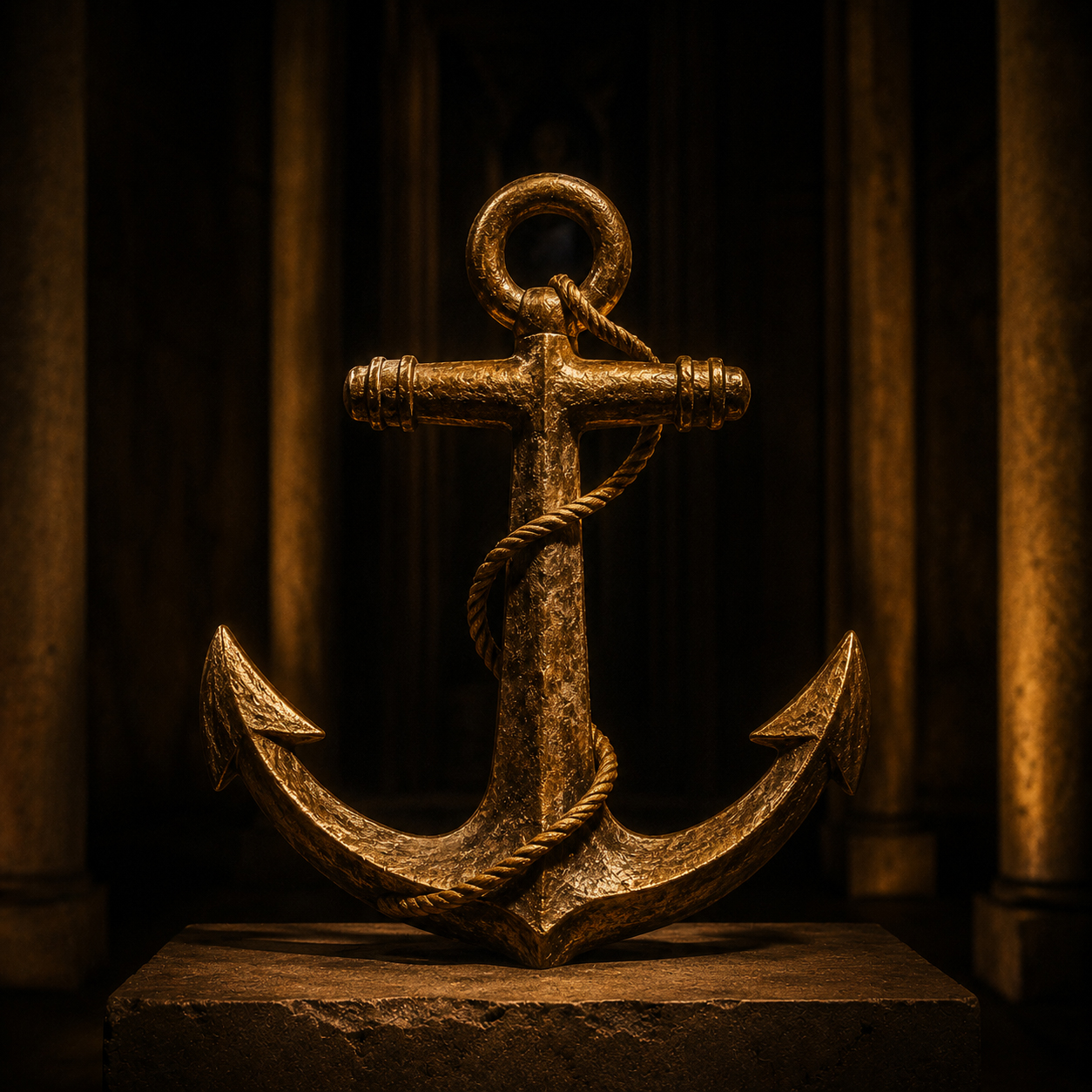
Anchor – Meaning, History and Symbolism
Stability is not standstill.
It is the strength to stay rooted in the storm.
The anchor does not hold through weight, but through resistance. It is the oldest sign that safety does not mean immobility – but a hold that carries you even in the storm.
Discover personal symbolism →Origin
The anchor has accompanied humankind since antiquity as the holding device of seafaring. Its symbolism grows directly from its function: an anchor that grips lets a ship withstand the storm without drifting. It is active safety in a passive situation.
In early Christianity it became the most important secret sign of the persecuted – even before the fish and the cross, because it carries the cross hidden within itself: shank and crossbar.
Use in Jewelry
In jewelry, the anchor appears as a pendant, ring, engraving or maritime detail. Since the Victorian triad of faith, hope, love (cross, anchor, heart), it has been a firm part of the language of symbols.
Finely crafted, the anchor does not appear decoratively maritime, but calm and steadfast – especially as a hand-forged piece with an engraving on the back.
Symbolic Meaning of the Anchor
The anchor is never just a maritime motif. Depending on the context, it stands for stability and safety, for hope in the Christian sense, for loyalty and steadfastness – or for the fixed point that remains even in the storm.
Its meaning grows from its mechanics: it holds because it responds to pressure by digging in. Stability here is not passivity, but an active force.
Stability
A sign of safety that does not cling, but carries you through the storm.
Hope
The oldest Christian sign of hope – the anchor of the soul.
Loyalty
Constancy toward a person, a conviction, a promise.
Steadfastness
The strength to stay in place, even when the pressure increases.
Safety in the Storm
It does not sugarcoat anything: there is a storm – and there is something that holds.
The Human Longing Behind the Symbol – Anchor
For many people, the anchor is first of all a maritime motif. But its true power lies deeper: it answers one of the oldest human questions – what holds us when the ground gives way?
The anchor does not sugarcoat anything. It does not say there is no storm. It says: there is a storm – and there is something that holds.
The Stoics called this inner hold one's own reason; for others it is faith, a relationship, a place, a memory. Perhaps that is why the anchor is given at turning points. It can say: What holds me has a name.
For the support that truly carries is rarely abstract. It is concrete: a person, a decision, a promise.
In jewelry, the anchor becomes especially powerful when it keeps this honesty – not a carefree sign, but a quiet commitment to what carries you.
The History of the Anchor as a Symbol
The anchor is one of the few symbols whose meaning grows directly from its technology. From ancient seafaring through early Christianity to the Victorian language of symbols, it stands for a hold that is not standstill.1
Antiquity & Mechanics
The anchor holds not through weight, but through geometry – active safety in a passive situation.
Read more
The anchor has been documented in the Mediterranean world since the 6th century BC. Its flukes dig into the seabed when cast: the stronger the pull, the deeper the hold. This principle of self-reinforcing resistance is the technical root of its symbolism.
The Romans associated the anchor with prudence: Emperor Augustus used the emblem 'Festina lente' (make haste slowly) as an anchor with a dolphin – stability and speed at once.
The humanist Aldus Manutius adopted this image as his publisher's mark – the most famous printer's device of the Renaissance. Every time a reader opens one of his books, they look upon an anchor.2
Early Christianity
The anchor was a secret sign of the Christians earlier than the cross.
Read more
Around 200 AD, Clement of Alexandria listed the motifs Christians were allowed to engrave in their signet rings: dove, fish, ship – and anchor. The cross is missing from this list. The anchor was the earlier sign of the persecuted.
The reason is symbolically precise: the anchor contains the cross hidden within it – its vertical shank and the crossbar. The Epistle to the Hebrews provides the source: 'We have this hope as a sure and steadfast anchor of the soul' (6:19).
From the catacombs of Rome and North Africa (2nd–4th century), rings and pendants have survived that often combine the anchor with a fish or dove – a confession in metal.
Seafaring & Heraldry
In the great era of naval power, the anchor became a sign of strength and identity.
Read more
In 1821, Richard Pering developed the Admiralty anchor of the Royal Navy – that basic form with a long shank, two flukes and a stock crossbar which defines the familiar image of the anchor to this day. An engineering standard became a global sign.
The Royal Navy made the anchor its official emblem. Sailors wore it as a tattoo, often combined with the word 'hope' or the name of their home town.
In late 19th-century jewelry, the anchor in cobalt-blue enamel and with rope motifs became socially acceptable for women as well – the maritime line as an elegant style.
Victorian Era & Modernity
Faith, hope, love: the anchor in the triad – and today as a clear sign.
Read more
The Victorian era developed the motif trio of cross (faith) – anchor (hope) – heart (love) into one of the most-produced jewelry sets in history. It goes back to the First Epistle to the Corinthians: 'And now abide faith, hope, love' (13:13).3
In mourning jewelry, the three-piece set was made of black jet – a code that communicated grief, sustaining faith and carrying hope all at once.
Since the 2010s, the minimalist anchor pendant in silver and gold has been among Europe's best-selling symbolic jewelry – often worn by people who know what stability means.
The Anchor in Jewelry
As a pendant, ring, engraving or maritime detail, the anchor remains timeless when it is designed in a clear and reduced way. Especially as a hand-forged piece, it unfolds its calm presence.
Anchor Pendant
Worn close to the body, the anchor becomes a quiet sign of stability and hope.
Anchor & Heart
In the triad of faith, hope, love, the anchor unites stability and affection.
Anchor Engraving
As an engraving on the back, the anchor carries coordinates, a date or a name.
From Symbol to Signature
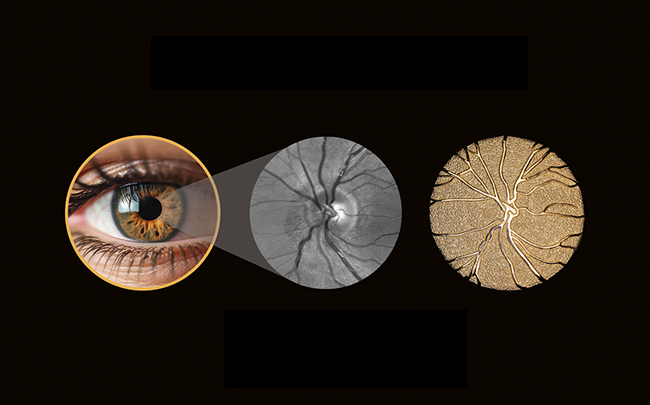
Universal symbols tell of shared meanings. RETINA® tells of one person: through the unmistakable signature of their retina.
The RETINA® Perspective
The anchor answers a universal question: what gives us stability? It can embody hope, loyalty, safety and steadfastness. But it does not yet say who or what in your life provides that hold.
This is exactly where personal symbolism begins. The anchor gives stability a form. A RetinaSignature connects this form with a specific person. Thus a familiar sign becomes a piece of jewelry that exists only once.
From the Anchor to the RetinaSignature
An anchor can make stability and hope visible. A RetinaSignature can show which person, which relationship or which memory carries that hold.
Discuss personal jewelry →Related RETINA® Pages


Related Symbols


Frequently Asked Questions About the Anchor Symbol Meaning
What does the anchor mean as a symbol?
The anchor stands for stability, hope, loyalty and steadfastness. As a seafaring sign, it became an emblem of safety that carries you even in the storm.
Why is the anchor a Christian symbol?
In early Christianity, the anchor was a secret sign – even before the cross. It contains the hidden form of the cross and refers to the Epistle to the Hebrews: hope as the 'anchor of the soul' (6:19).
What does an anchor mean in jewelry?
Anchor jewelry can express stability, hope, loyalty or a fixed point of reference in life. It is especially powerful when it is tied to a specific person or memory.
What do anchor, heart and cross stand for together?
The Victorian three-piece set stands for faith (cross), hope (anchor) and love (heart) – after the First Epistle to the Corinthians (13:13).
Is the anchor only a maritime symbol?
No. Beyond seafaring, the anchor stands for inner stability, steadfastness and the strength to stay rooted in times of crisis.
Is anchor jewelry timeless?
Yes, if the design remains clear. A reduced, precisely crafted anchor appears more timeless than a decorative maritime motif.
Is the anchor suited to memorial jewelry?
Yes. The anchor can honor a hold that remains – a person, a decision, a place – especially as an engraving on the back.
Which symbols go well with the anchor?
Heart, North Star, Tree of Life and cross extend the anchor with love, orientation, rootedness and faith.
What is more personal than an anchor?
The anchor stands for a universally understood idea. A RetinaSignature additionally refers to a specific person and can therefore exist only once.
Sources and Further Reading
Show sources on the history of the symbol
1) On the Stoic philosophy of inner stability (Epictetus, Marcus Aurelius): Stanford Encyclopedia of Philosophy: Stoicism
2) On the publisher's mark of the anchor and dolphin: Encyclopaedia Britannica: Aldus Manutius
3) On the symbolism of faith, hope, love in jewelry: Victoria and Albert Museum: A History of Jewellery


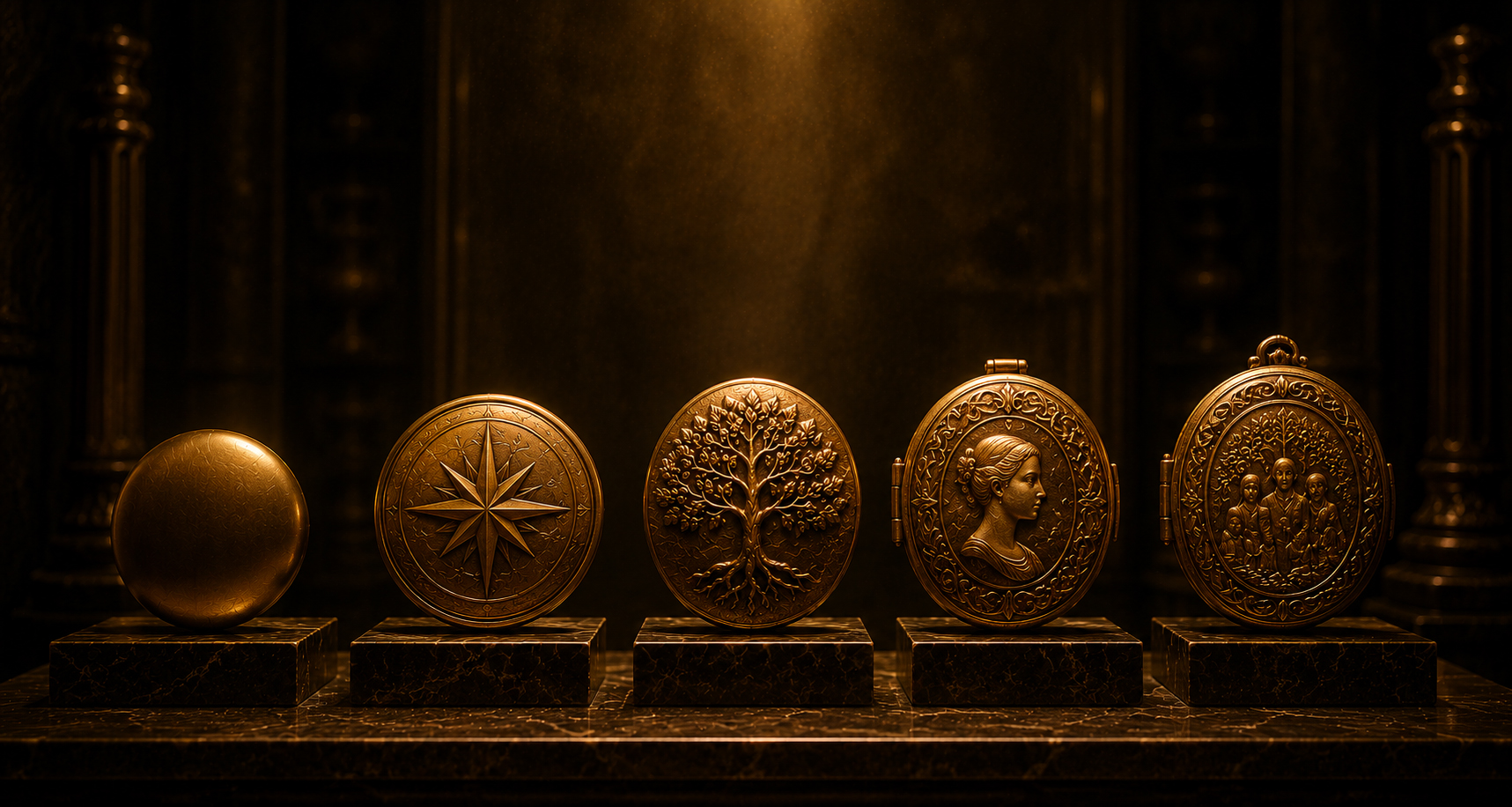
Jewelry That Makes Meaning Visible
A symbol can open a story. A RetinaSignature makes it personal. Discover jewelry that gives identity, memory and connection an unmistakable form.
Get in touch →